Father Mulligan
The God of Small ThingsFather Mulligan is an Irish monk whose year in Kerala leaves a lasting mark on Baby Kochamma: she falls in love with him, pursues the possibility of closeness through religious devotion, and continues to imagine their intimacy after his death. His own path moves in the opposite direction, from a Catholic mission to the study of Hindu scriptures and, eventually, to Vaishnavite faith. The distance between his changing religious life and her unchanging attachment makes him central to a story of love that survives not as a shared relationship but as a private memory Baby Kochamma can reshape.
Identity and Arrival
At eighteen, Baby Kochamma falls in love with Father Mulligan, a young Irish monk in Kerala for a year on deputation from his seminary in Madras. He is studying Hindu scriptures so that he can denounce them intelligently. The purpose of his study is initially polemical, though his later life carries him toward a different understanding of faith.
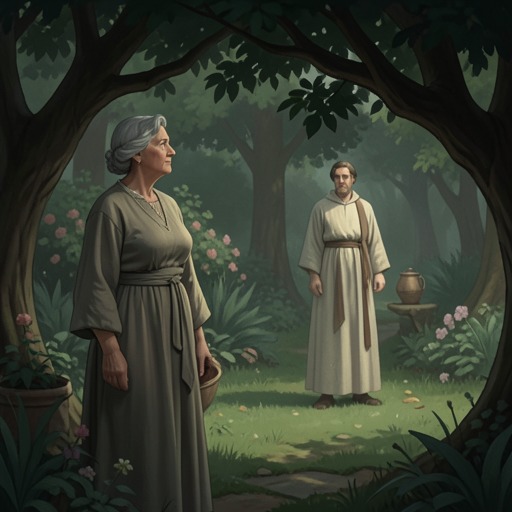
Every Thursday morning, Father Mulligan visits Baby Kochamma’s father, Reverend E. John Ipe, a priest of the Mar Thoma Church. The regularity of these visits makes him a familiar presence in the household, but not a visitor whose attention belongs to Baby Kochamma. He and Reverend Ipe enjoy one another’s company despite their age difference and their affiliation with Christian denominations marked by mutual distrust. Father Mulligan is often invited to stay for lunch; Baby Kochamma remains near the table after the meal has ended, while her father and his guest converse.
Baby Kochamma’s Pursuit
Baby Kochamma tries first to make an impression through staged acts of charity on Thursday mornings, timing them for Father Mulligan’s arrival. The gestures do not produce the response she hopes for. The visits continue, but there is no evidence that Father Mulligan understands the desire behind her efforts or returns it.
When his year in Kerala ends and he is due to return to Madras, Baby Kochamma shifts her hopes from charity to religious commitment. Against her father’s wishes, she converts to Roman Catholicism, obtains special dispensation from the Vatican, takes vows, and enters a convent in Madras as a trainee novice. She imagines that this choice might create a legitimate reason to be near Father Mulligan, picturing conversations about theology in the convent’s rooms. Her ambition is limited and intensely personal: proximity, rather than a formal claim on him.
The convent does not bring her closer. Senior sisters have greater access to priests and bishops, and Baby Kochamma realizes that she may wait years before she can approach Father Mulligan. She becomes restless and unhappy, develops an allergic rash on her scalp from the friction of her wimple, and feels more isolated because she believes her English is better than that of those around her. Within a year, she begins sending puzzling letters to her father. The available account records her disillusionment and loneliness, but does not detail the contents or consequences of those letters.
A Changed Faith and a Continuing Connection
Father Mulligan’s own religious course changes over time. His study of Hindu scriptures, which began as preparation for theological criticism, leads first to curiosity and eventually to a change of faith. Fifteen years before the later account, he becomes a Vaishnavite devotee of Lord Vishnu and lives in an ashram north of Rishikesh. He nevertheless remains in contact with Baby Kochamma, writing to her every Diwali and sending a greeting card each New Year.
One photograph he sends shows him addressing a spiritual gathering attended by middle-class Punjabi widows, dressed in white. Father Mulligan appears in saffron, with long, carefully groomed white hair and beard. Baby Kochamma is offended by the image: she had hoped, in effect, that his eventual renunciation might bring him back toward her, but he has taken new vows instead. The photograph makes visible a change in his life that her devotion cannot direct. His continuing correspondence preserves a connection, but the evidence does not suggest that it becomes a romantic relationship.
Death and the Life of Memory
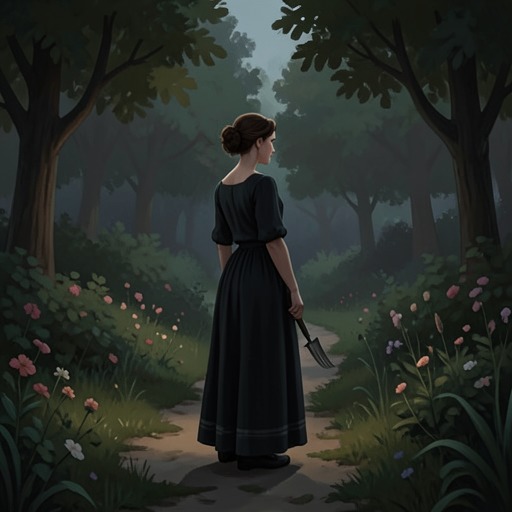
Father Mulligan dies of viral hepatitis in an ashram north of Rishikesh, four years before the later events in which Baby Kochamma is shown keeping her diary. His death does not end her attachment or alter its habitual expression. Night after night, year after year, she writes the same declaration of love. The diary is not a record of a developing relationship; its repeated entry holds her feeling in place, unchanged by the passage of time or by the fact that he is dead.
In memory, Baby Kochamma reverses the rejection she experienced in life. She imagines Father Mulligan as embracing her and reconstructs him in the form in which she most wants to remember him: not in saffron as a Vaishnavite, but in the Catholic clothing associated with his Thursday visits. In that private version, she restores the familiar visitor who came to lunch and removes the religious choices that took him elsewhere. His death grants her exclusive possession of this remembered figure, though that possession exists only in her imagination.
Narrative Significance
Father Mulligan’s character is drawn through the contrast between movement and repetition. He changes: his intellectual engagement with Hindu texts develops into a new faith, and his life proceeds beyond the Catholic identity that first gave Baby Kochamma hope of closeness. She does not make a corresponding change. Her attempted conversion is undertaken as a route toward him, and when that route fails, the enduring bond becomes a ritual of memory, repeated in identical diary entries.
The narrative therefore presents him less through an independent account of his inner life than through the successive meanings Baby Kochamma assigns to him: the monk who visits her father, the imagined companion she hopes to meet in the convent, the correspondent who sends annual greetings, and the beloved she recreates after death. That perspective marks a limit as well as a tenderness. Father Mulligan’s religious choices remain his own, while Baby Kochamma’s memory converts them into a story of personal rejection and imagined reunion. His significance lies in this tension between the life he leads and the version of him she keeps.